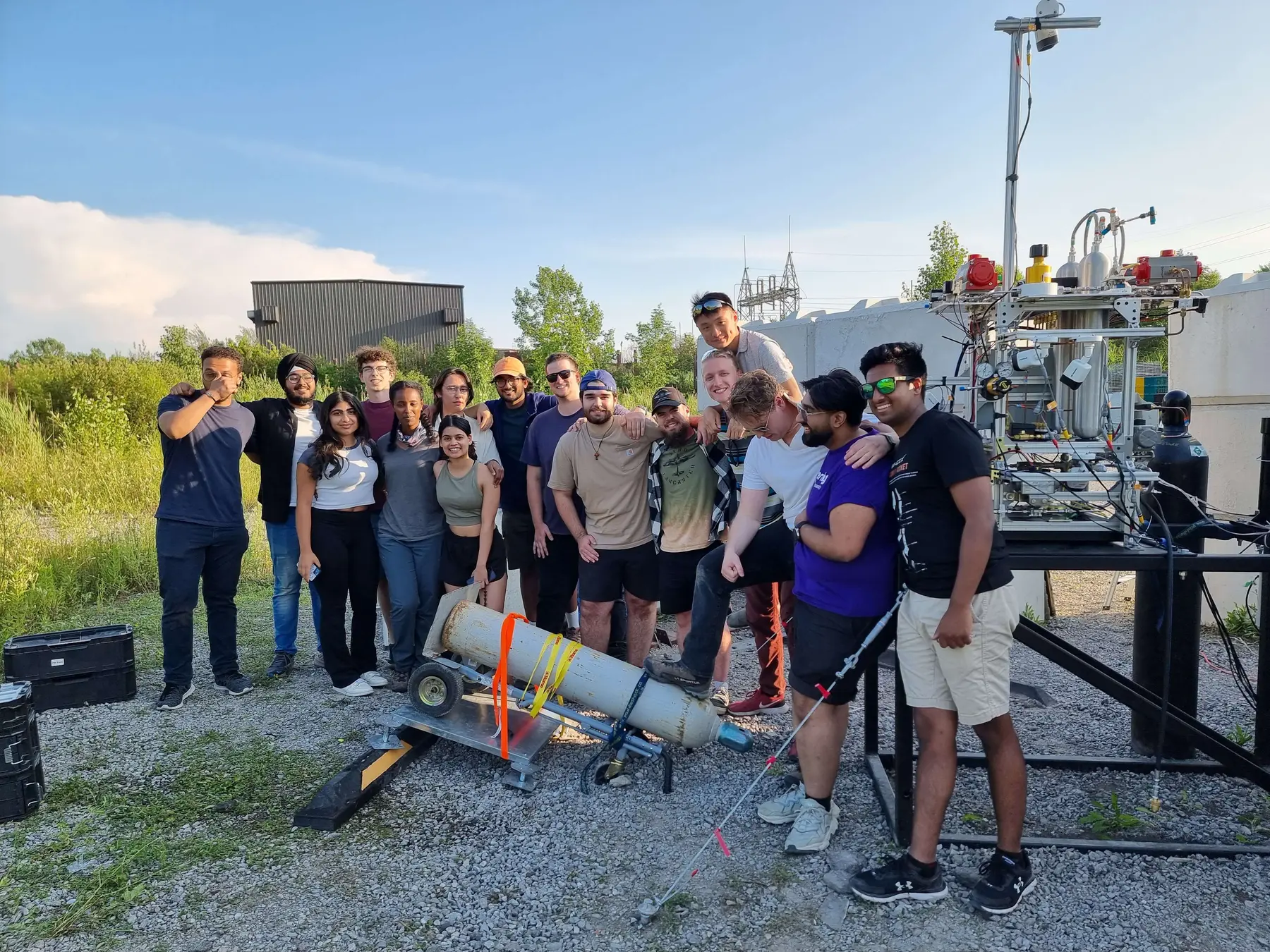
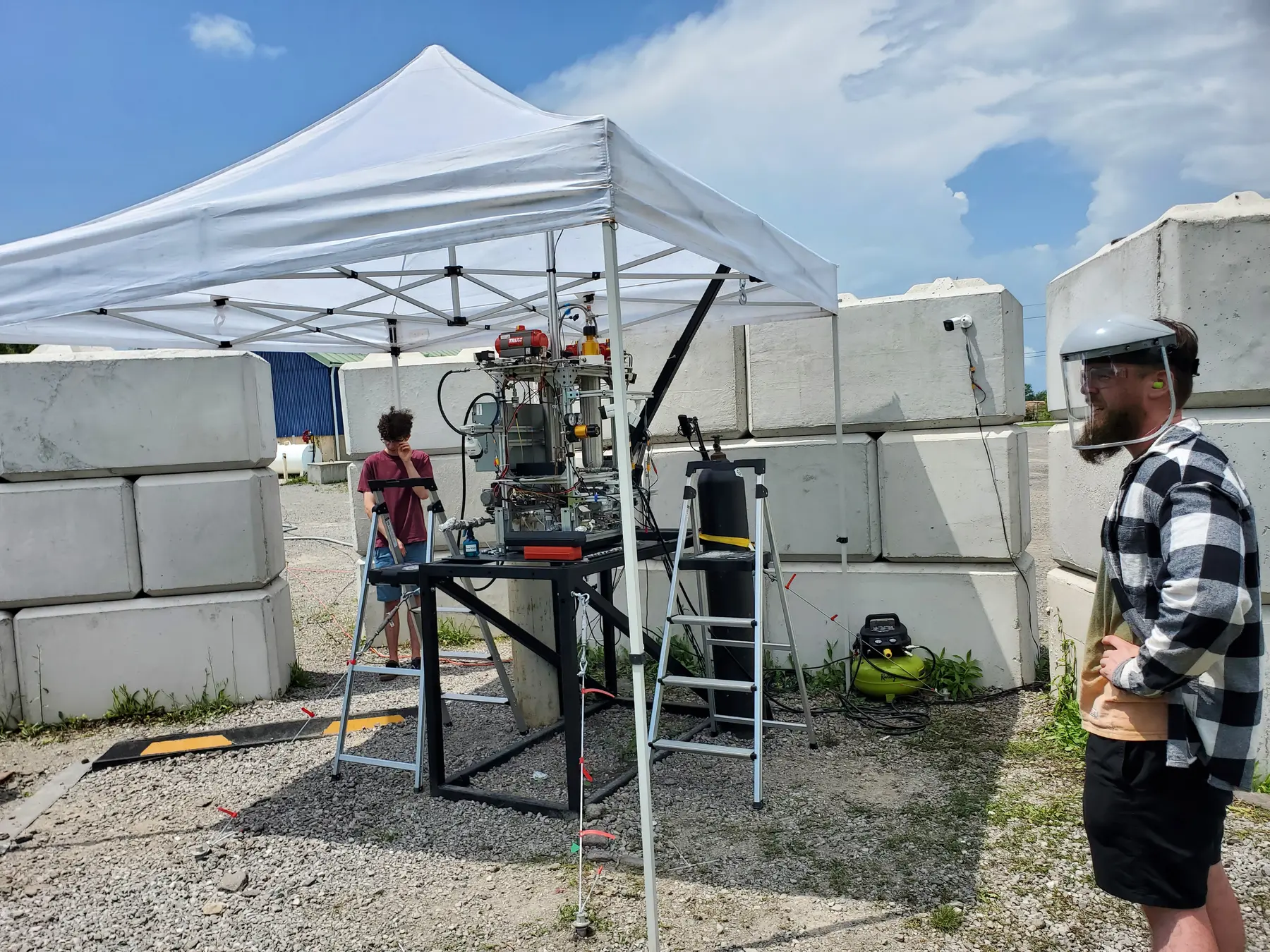
Spender Cold-Flow Campaign 3 - July 22nd–23rd, 2023
Water and carbon dioxide were flowed separately and together to exercise the complete propellant-management system ahead of Launch Canada.
Test sequence
The campaign completed two inert flows. The first flowed the water and carbon-dioxide circuits separately; the second flowed both circuits together. A supplier issue required the carbon-dioxide cylinder to be inverted, so the team flowed water, safed the stand, inverted and loaded the carbon-dioxide cylinder, completed its flow within the one-hour operating window, then refilled water and changed the nitrogen supply before the combined run.
These were Spender's first verified successful integrated flows. The campaign exercised the plumbing stack, valves, control system, telemetry and operating procedures.
Final reported measurements
| Circuit and simulant | Regulator droop | Steady-state mass flow | Experimental discharge coefficient |
|---|---|---|---|
| Fuel side, water | 181.5 psi | 0.162 kg/s | 0.83 |
| Oxidizer side, carbon dioxide | 182.5 psi | 0.354 kg/s | 0.76 |
Data qualification
The first same-week calculation reported a water-equivalent average of 0.182 kg/s against 0.2132 kg/s theoretical, for a discharge coefficient of 0.8558. The final Launch Canada report revised the water result to 0.162 kg/s and 0.83 and reported the carbon-dioxide result as 0.354 kg/s and 0.76. The final report is the baseline above. The preliminary value is retained because pressure values froze during parts of the sequence, some records were out of time order, and engine-computer data storage was marked only partially complete.
The final analysis concluded that injector-throat tuning was still required, but the system could proceed to an initial hot-fire attempt at reduced expected performance.